Cars · Diagnostics
Understanding Absolute Pressure in ECU Tuning
An overview of absolute pressure measurement in automotive tuning, explaining the relationship between atmospheric pressure, boost, and vacuum.
Absolute pressure is a measurement scale where absolute vacuum is defined as 0. In automotive engine management, this scale is critical for calculating air density and fuel requirements.
Pressure Definitions
- Atmospheric Pressure: Approximately 14.7 psi at sea level.
- Boost Pressure: Measured as gauge pressure. To calculate absolute pressure, add atmospheric pressure to the boost value (e.g., 10 psi of boost + 14.7 psi atmospheric = 24.7 psi absolute).
- Tire Pressure: Similarly, a tire gauge reading of 30 psi represents approximately 44.7 psi absolute pressure.
Note
Absolute pressure calculations must account for altitude, as atmospheric pressure decreases as elevation increases.
ECU Mapping and Absolute Pressure
Tuning software often utilizes absolute pressure scales for fuel and ignition tables.
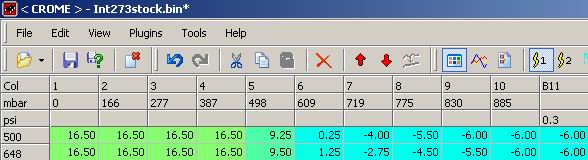
- Atmospheric Columns: In the example above, column 10 represents atmospheric pressure. Values may appear slightly lower than 14.7 psi due to interpolation or minor pressure drops at wide-open throttle (WOT).
- Vacuum Columns: Column 1 represents a vacuum state, though it is rarely calibrated to absolute zero.
Related Components
For further information on how the ECU interprets these pressure values, refer to the following:
- MAP Sensor0: Review the operational limits and voltage scaling of the OEM manifold absolute pressure sensor.
- Atmospheric Pressure Sensor0: Details on the barometric pressure sensor used for altitude compensation.