Willem EPROM Programmer Guide
Configuring and using Willem EPROM programmers (parallel/LPT port) for burning SST 27SF512 and 27SF256 ROM chips for Honda ECUs.
Adapted from pgmfi.org wiki
The Willem EPROM Programmer is a popular, open-hardware design ROM burner that has been a budget favorite of the Honda tuning community for socketing and burning custom ECU maps. Because it is an open-design board, it is sold under many names (such as "Enhanced Willem", "Dual Powered Willem", etc.) and manufactured by various sellers.
While highly cost-effective and capable of burning standard Honda ROM chips like the 27C256 (OTP), 29C256 (EEPROM), and SST 27SF256 / 27SF512 (flash), the programmer relies on a legacy parallel (LPT) port and can be challenging to configure.
Warning: Parallel Port (LPT) and OS Requirements: The Willem programmer requires a true hardware parallel port (standard base address
0x378hor0x278h) to communicate with the PC. Simple USB-to-Parallel printer adapter cables do not work because they do not support direct I/O port mapping. To run the Willem software, you must use a motherboard with an onboard LPT header or a dedicated PCI/PCI-e parallel card, and a compatible Windows OS (often requiring 32-bit versions or legacy port drivers likeUserPort/io.dllto permit direct hardware access).
Programming SST 27SF512 Chips (512k Flash)
The SST 27SF512 is a 512kbit (64 Kilobyte) flash memory chip that is commonly used to emulate or replace standard 256kbit (32 Kilobyte) EPROMs. Because it is twice the size of a standard OBD0/OBD1 Honda ROM (32KB), you must configure the software to write the bin file to the upper half of the chip using a hardware or software offset.
Step-by-Step Programming Guide
- Connect and Initialize: Connect the parallel cable and power source (USB power or DC adapter) to the Willem board. Ensure your parallel port drivers (e.g., DLPortIO) are active.
- Configure DIP Switches: Set the board's DIP switches according to the software's visual representation for the
SST27SF512device. - Insert the Chip: Insert the SST 27SF512 into the ZIF socket. Align the chip so that Pins 14 and 15 are at the bottom slots (closest to the ZIF handle) with the notch facing upward (away from the lever).
- Erase the Chip: In the software, click the Erase icon (depicted as a chip with an eraser).
- If the erase operation fails, verify that the board's mode jumper is set to the Erase position as shown in the hardware settings screenshot.
- Set Jumper for Programming: Swap the board mode jumper from the Erase configuration to the Program/Normal configuration.
- Apply the 32KB Offset: In the bottom right corner of the Willem software window, locate the Offset (Hex) input field. Change the default value of
0to8000(which corresponds to32,768bytes in decimal). This shifts the data to the upper32KBof the chip. - Load and Burn: Load your compiled
.binfile. Click the Program icon (complete chip illustration). When the popup appears asking if you want to use the specified hex offset, select Yes. - Verify: The software will burn the data and automatically run a verification pass. Ensure both operations complete successfully with a
100%status. - Final Verification: Insert the chip into your ECU's socket. Turn the ignition switch to the RUN position (engine off). The main relay should click and the Check Engine Light (CEL) should turn off after 2 seconds. If the CEL stays solid, the chip was not burned or offset correctly.
Configuration Screenshots (27SF512)
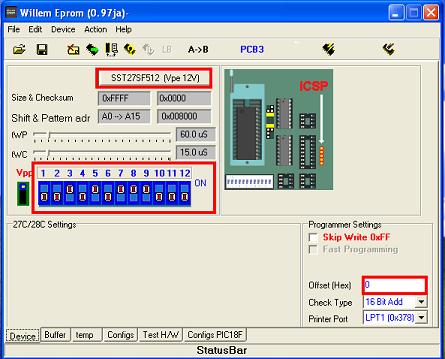 Willem Software Device Configuration
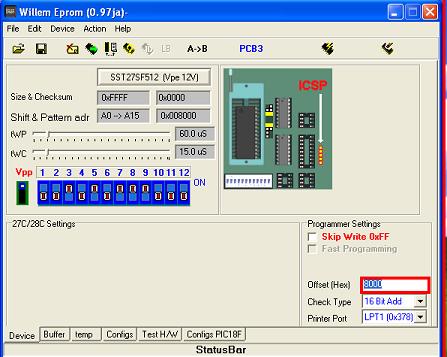 Willem Software Buffer and Offset Configuration
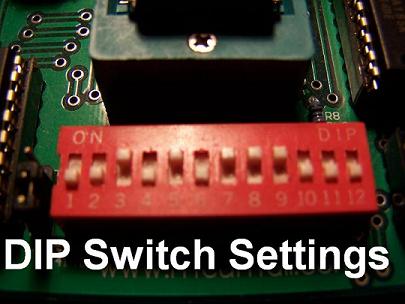 Willem Board DIP Switch Configuration
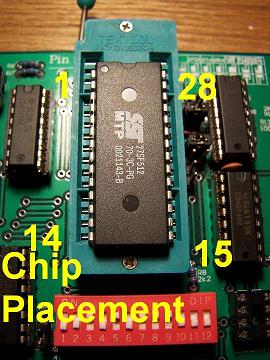 SST 27SF512 Chip Placement in ZIF Socket
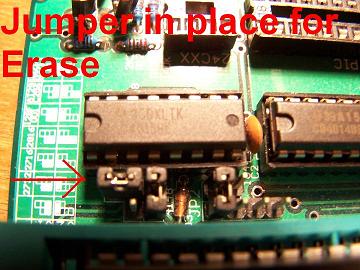 Willem Board Jumper Position for Chip Erasing
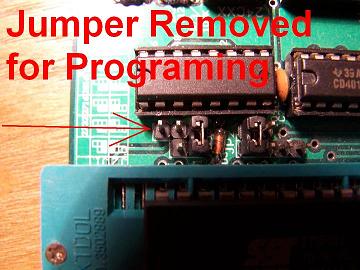 Willem Board Jumper Position for Chip Programming
Programming SST 27SF256 Chips (256k Flash)
The SST 27SF256 is a native 256kbit (32 Kilobyte) chip, meaning it matches the standard Honda ROM size perfectly. No software offsets are required, but the board configuration jumpers must be adjusted.
Erasing the SST 27SF256
Unlike standard EPROMs which require UV light to erase, the SST 27SF256 is electrically erasable. However, specific jumpers must be repositioned to permit the high erase voltage to route correctly:
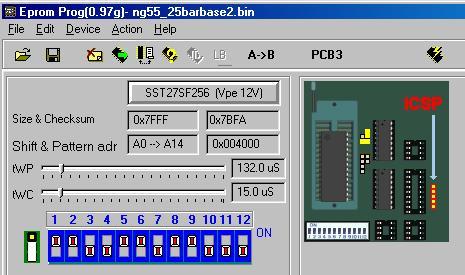 Willem Board Jumper Configuration for Erasing SST
 27SF256
Burning the SST 27SF256
To burn the SST 27SF256, return the jumpers to the PCB3 burn position (do not leave them in Willem mode):
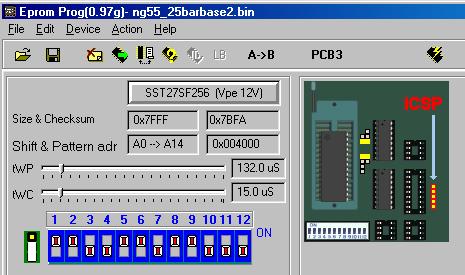 Willem Board Jumper Configuration for Burning SST
 27SF256
Credits and source
Authors drdisco69, 4g vtec
Source Adapted from Willem on pgmfi.org wiki. Licensed under CC BY-NC-SA 1.0.