Setting Idle Mixture and Balancing Dual Carbs on a D14A1
Set D14A1 dual Keihin idle mixture, tick-over, and balance: screw locations, CO/HC targets, left-vs-right adjuster, and dyno lessons from lean setups.
Adapted from Dual carb tuning on a D14A1, my own experiences , Adjusting air/fuel mixture on dual carbs GL d14a1 , Location of air/fuel mixture screws on D14A1 , Dual Carb Tuning Guide , D14A1 cleaned Carbs results , D15B4 (AUDM) Dual Carb tuning - with wideband and AFM , How To - Carb Cleanup and Refresh

Procedure for warm idle mixture, tick-over, and dual-carb balance on a Honda D14A1 dual Keihin CV setup (fourth-generation Civic GL and related dual-carb cars). Use after a carb rebuild or when the engine is luggish, uneven, or fails exhaust emissions.
Tip
Ideal workflow: set rough idle → set mixture (CO or wideband) → balance airflow between bodies → re-check idle and mixture. Expect to iterate two or three times.
Tools
- Exhaust gas analyser (CO% and, where tested, HC ppm) or wideband AFR with a safe sample point
- Tachometer or multi-function engine analyser (idle rpm / dwell)
- Small flat screwdriver for mixture screws
- Phillips screwdriver for idle speed screw
- 8 mm spanner + screwdriver for balance locknut / screw
- Length of hose for the field “ear” balance method if no manometer / Carbtune is available
Locate the adjusters
Idle mixture screws
On many D14A1 dual-carb sets, each idle mixture screw sits under a white plastic blanking disc. Pry carefully and adjust both sides equally in small increments (left and right bodies each have a screw).
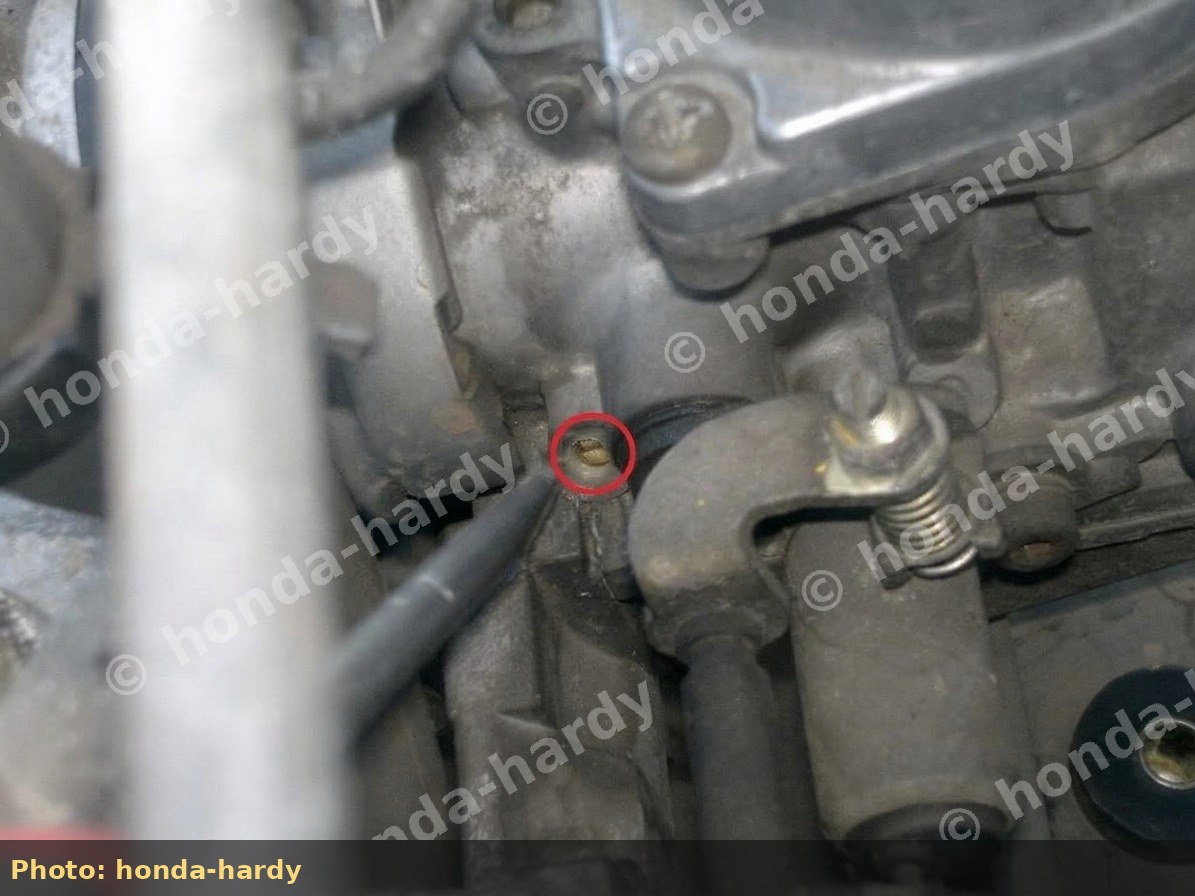
Idle mixture screw location (honda-hardy).
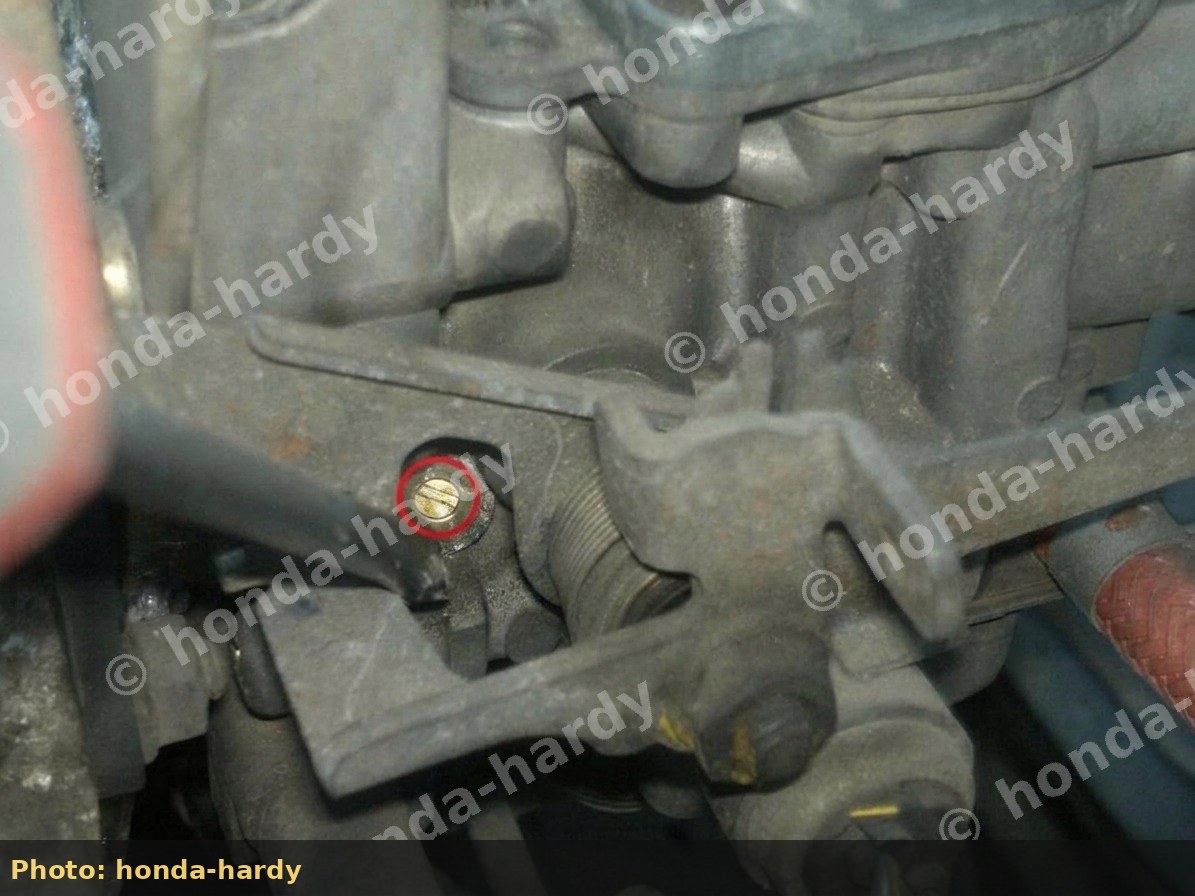
Opposite-body mixture screw (honda-hardy).
Idle speed screw
Follow the throttle cable to the carb linkage. The idle speed (tick-over) screw is the Phillips adjuster at the linkage - turn clockwise to raise idle on most layouts. Mixture changes often raise idle; re-set after every mixture pass.
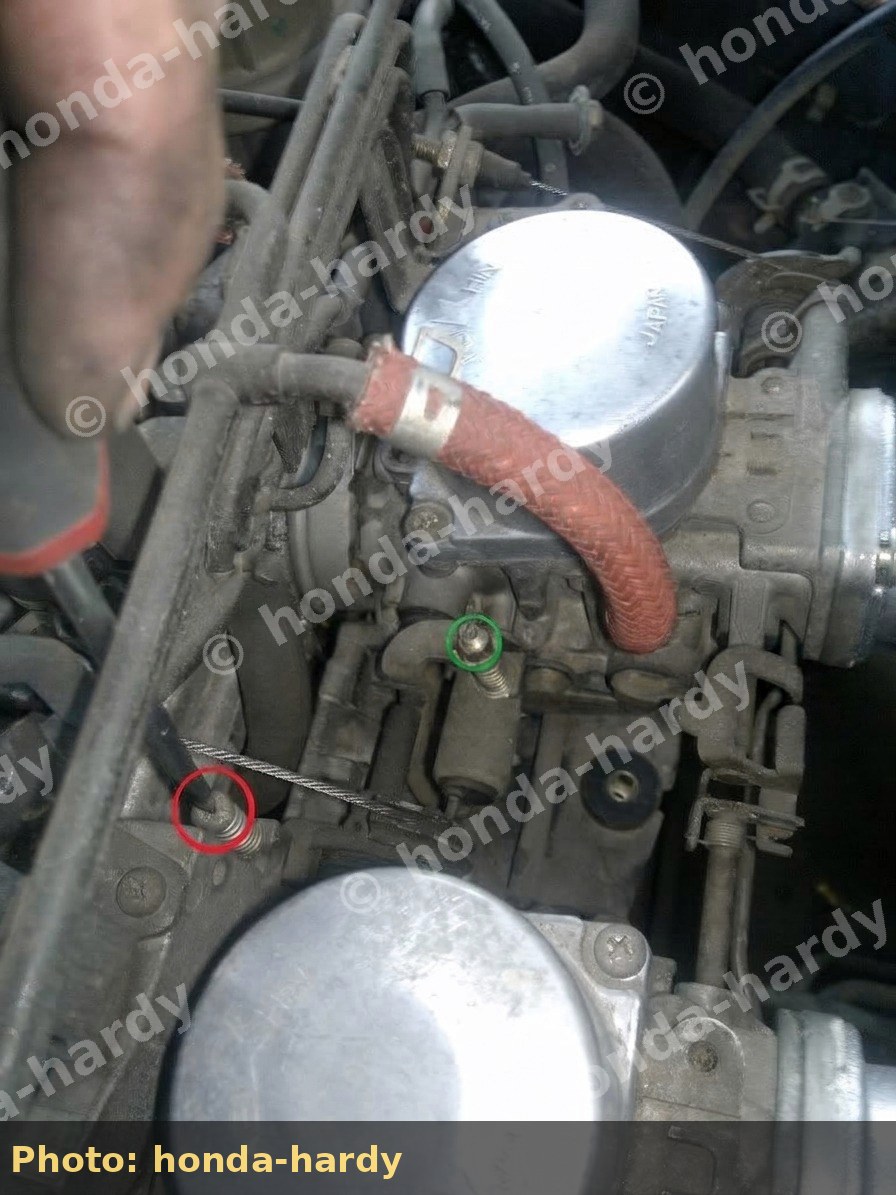
Idle speed screw at throttle linkage (honda-hardy).
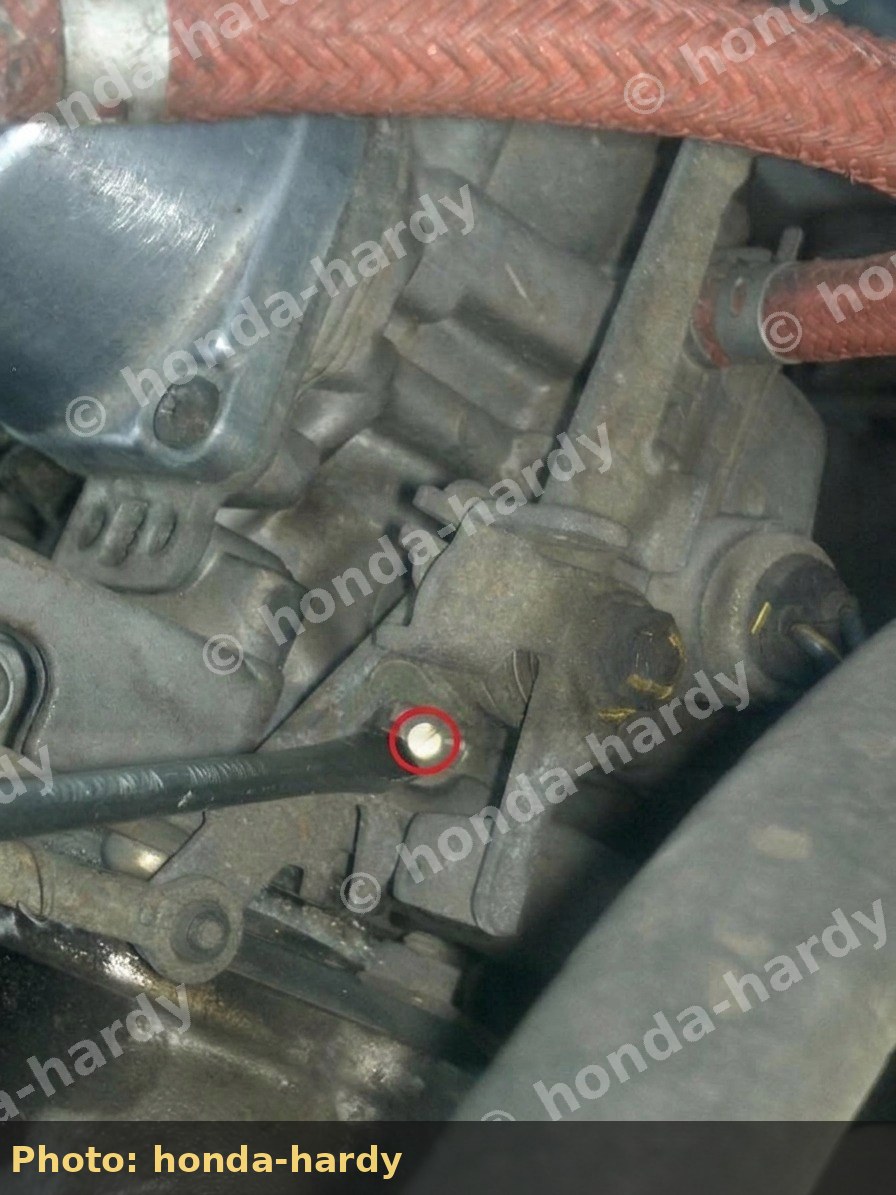
Another linkage/adjuster location circled for identification (honda-hardy).
Balance (synchronisation)
Important
On typical dual Keihin layouts used here, the right-hand carb is the fixed reference; the left-hand carb is adjustable relative to it (locknut + centre screw). Confirm on your linkage before turning the wrong screw.
An 8 mm spanner commonly fits the balance locknut: hold the centre screw, loosen the nut, adjust, re-lock.
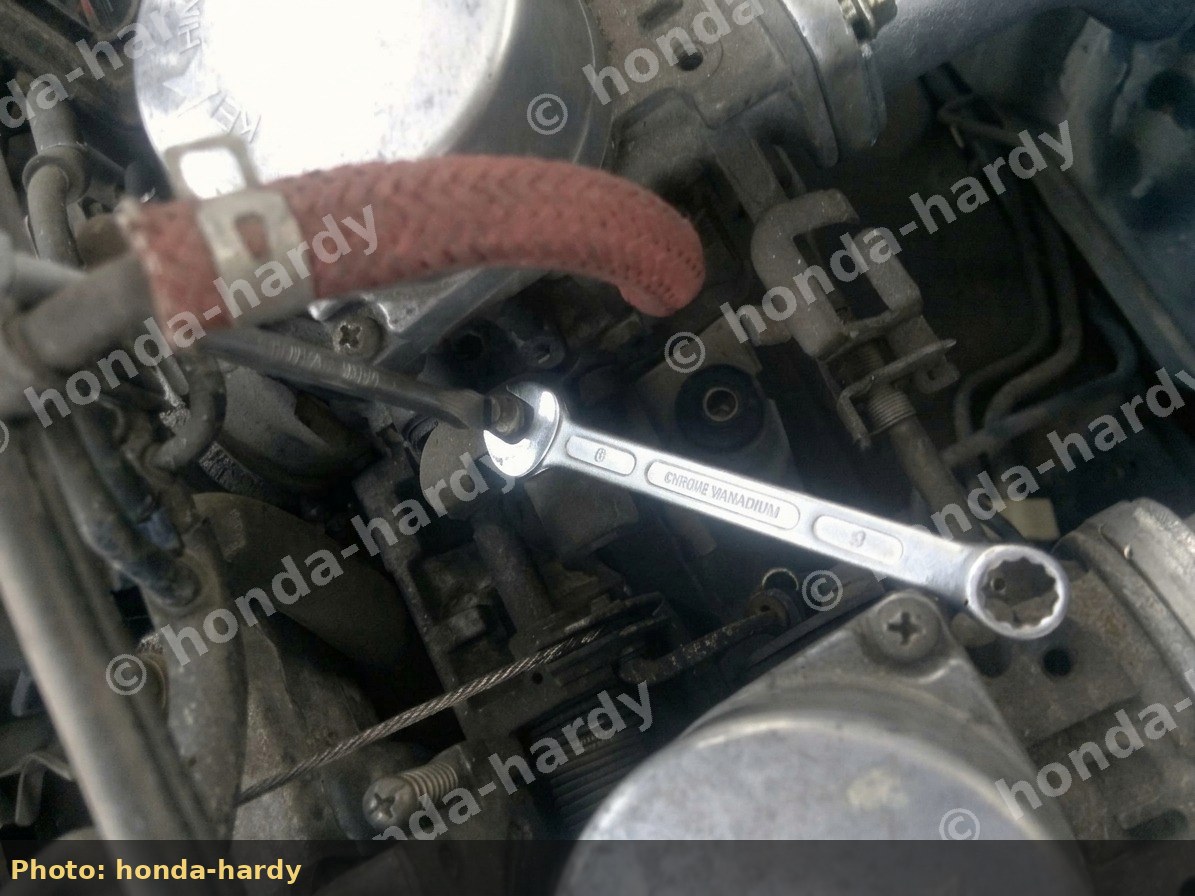
Balance locknut and adjuster (honda-hardy).
Target values (street baseline)
| Parameter | Community street target | Notes |
|---|---|---|
| Warm idle CO | ~0.9-1.0% | Example: 0.2% CO was too lean and cost large dyno power; final setup ~0.87% CO reported “good” |
| Hydrocarbons (MOT-style) | e.g. ~400 ppm vs a 1200 ppm limit in one UK test | Always use your local limits |
| Warm idle speed | ~750-800 rpm | Example set point: 775 rpm |
| Cruise AFR | near ~14.7:1 | After idle is sorted |
| WOT AFR | not lean of ~12.8-13.0:1 without data | Log under load |
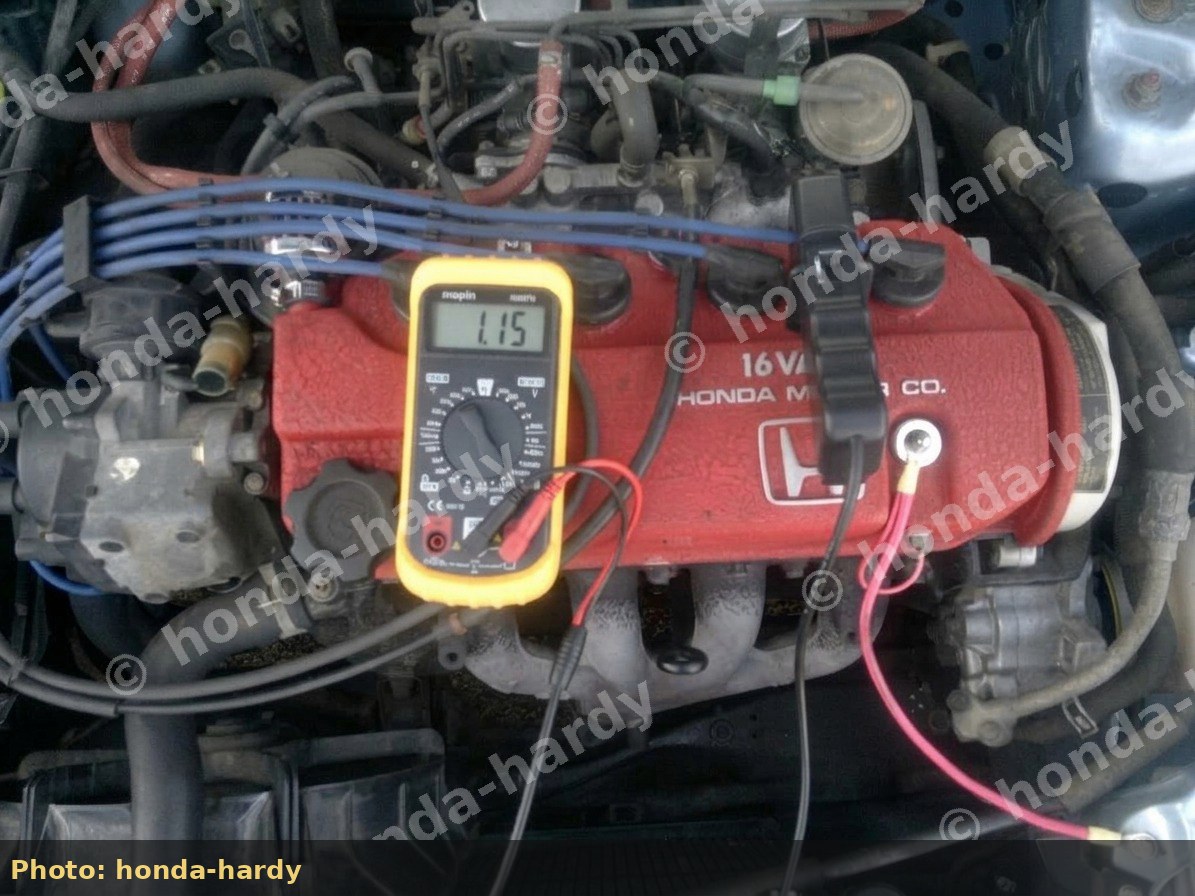
Warm idle set near 775 rpm (honda-hardy).
Step-by-step
- Warm the engine fully; chock wheels; handbrake on; load electrical accessories as you will for the emissions test if that is the goal.
- Baseline idle near the service-manual value.
- Mixture: turn each mixture screw a fraction of a turn equally until CO ≈ 1% or idle AFR is stable (not lean-misfire, not sooty rich).
- Re-set idle speed if rpm rose or fell.
- Balance airflow:
- With trumpets fitted, or with the airbox lid and filter removed so both throats are open.
- Hose-to-ear: hold one end to your ear, the other to the right (fixed) throat, then the left throat; match pitch/strength.
- Adjust only the left balance screw; lock the 8 mm nut.
- Prefer a manometer / Carbtune when available - hose-to-ear is a field method.
- Re-check idle speed and mixture after balance (balance often changes both).
- Road test: hesitation often means balance or needle transition; surge at cruise often means mixture; flat WOT often means main jet / spring / restrictor.
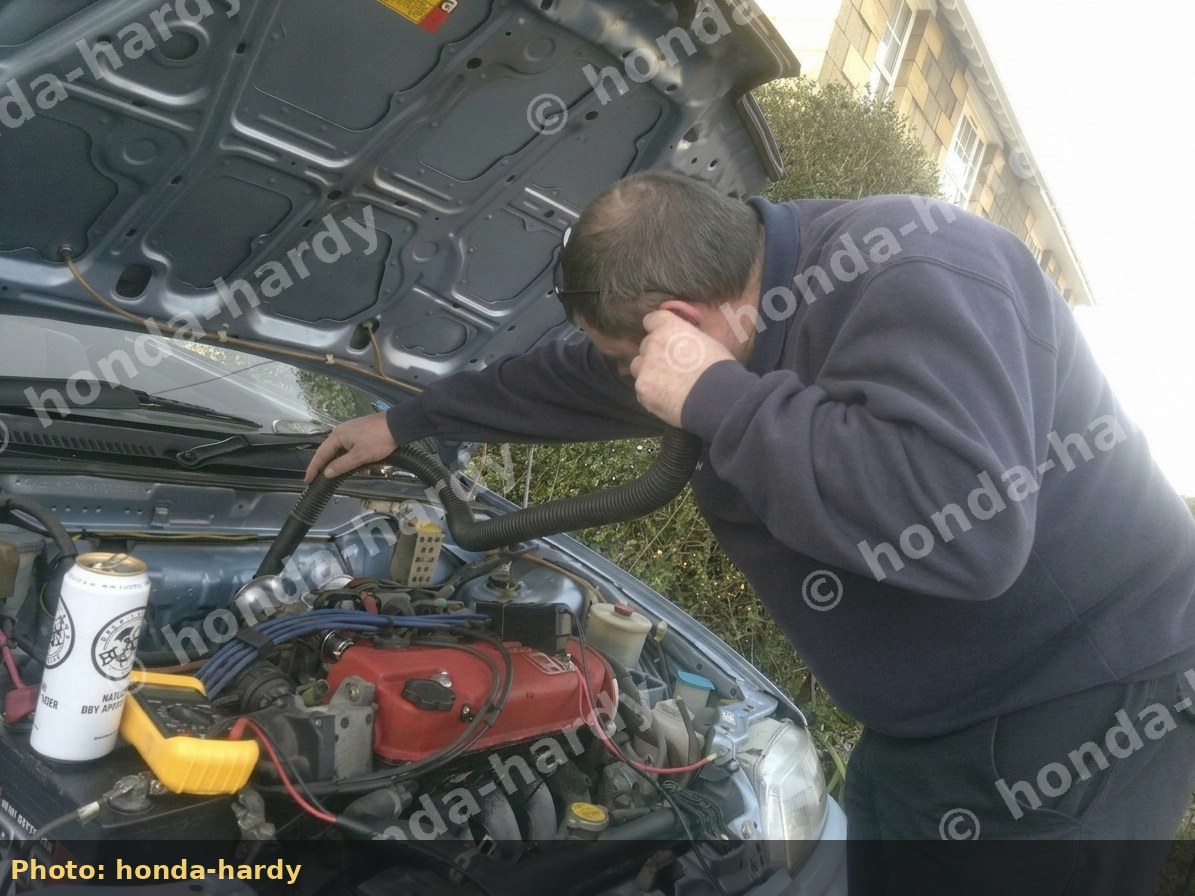
Field balancing with a hose (honda-hardy).
Dyno lesson (open stacks + lean idle)
A dual-carb D14 on trumpets/filters with cut springs and ~0.2% CO struggled around ~75 bhp. Pulling the choke as a crude enrichment test recovered about 86.4 bhp. That does not mean “run on choke”; it means fuel must match airflow.
After correcting idle mixture toward ~1% CO, balancing, and re-setting idle, the same car was reported driveable again on trumpets - still subject to proper WOT jetting.
Warning
Do not leave the choke partially open as a tune. Fix jets, needles, mixture screws, vacuum leaks, and balance.
What the idle screws cannot fix
On dual Keihin CV carbs:
- Idle / light-load mixture screws mainly affect the slow circuit.
- WOT is dominated by the main jet (and needle taper when the slide is high). Turning idle screws will not fix a 10:1 full-load log.
- After a thorough carb clean, warm idle often rises (cleaner passages, better balance). Re-set tick-over; do not assume you must cut springs because idle climbed after cleaning.
Carb cleanup before tuning
A dirty dual-carb set often feels flat or hesitant at WOT even when the rest of the car is healthy. Community how-tos start by lifting the CV Dual Carb airbox lid, removing the piston lids (stubborn screws often free with a light hammer tap on the screwdriver), and cleaning the slides/needles with carb cleaner - then re-fitting carefully so the slide keyway lines up.
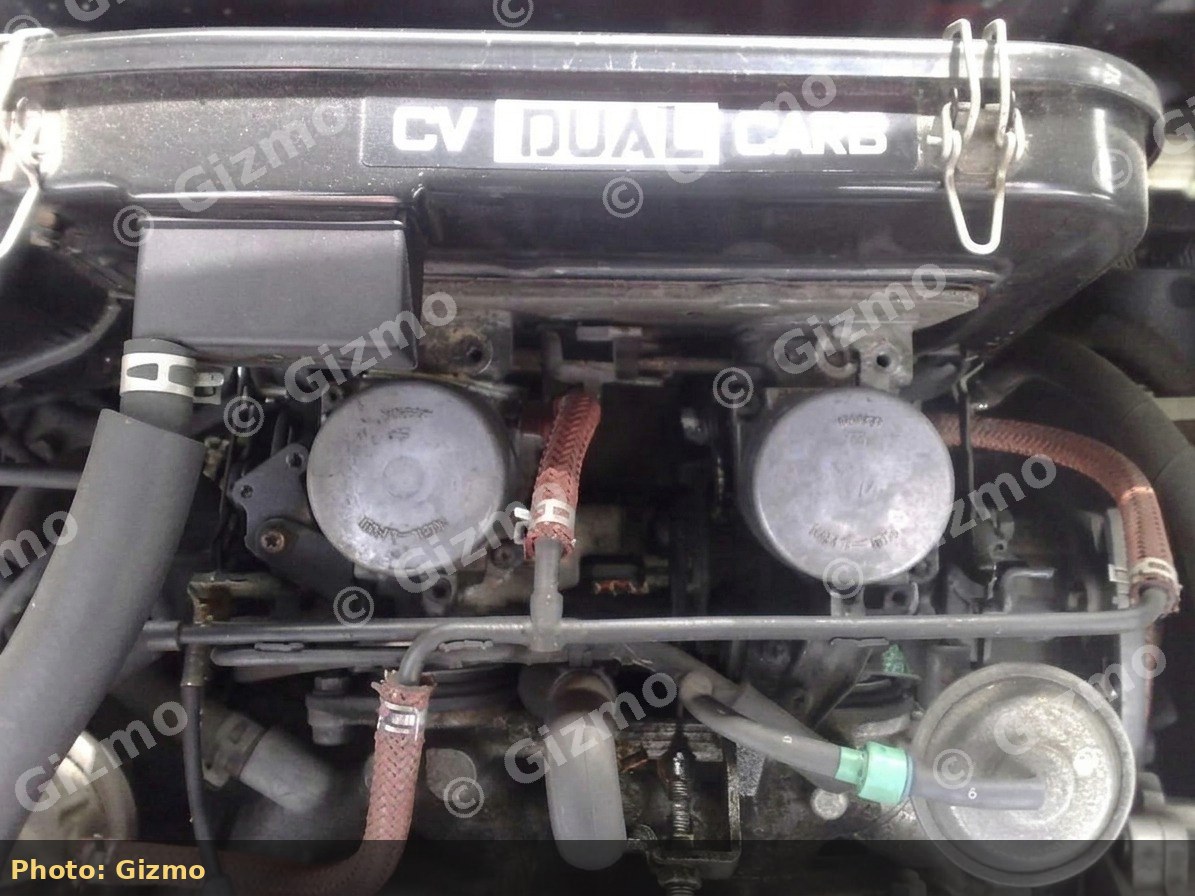
Stock dual Keihin lids under the factory airbox lid (Gizmo).
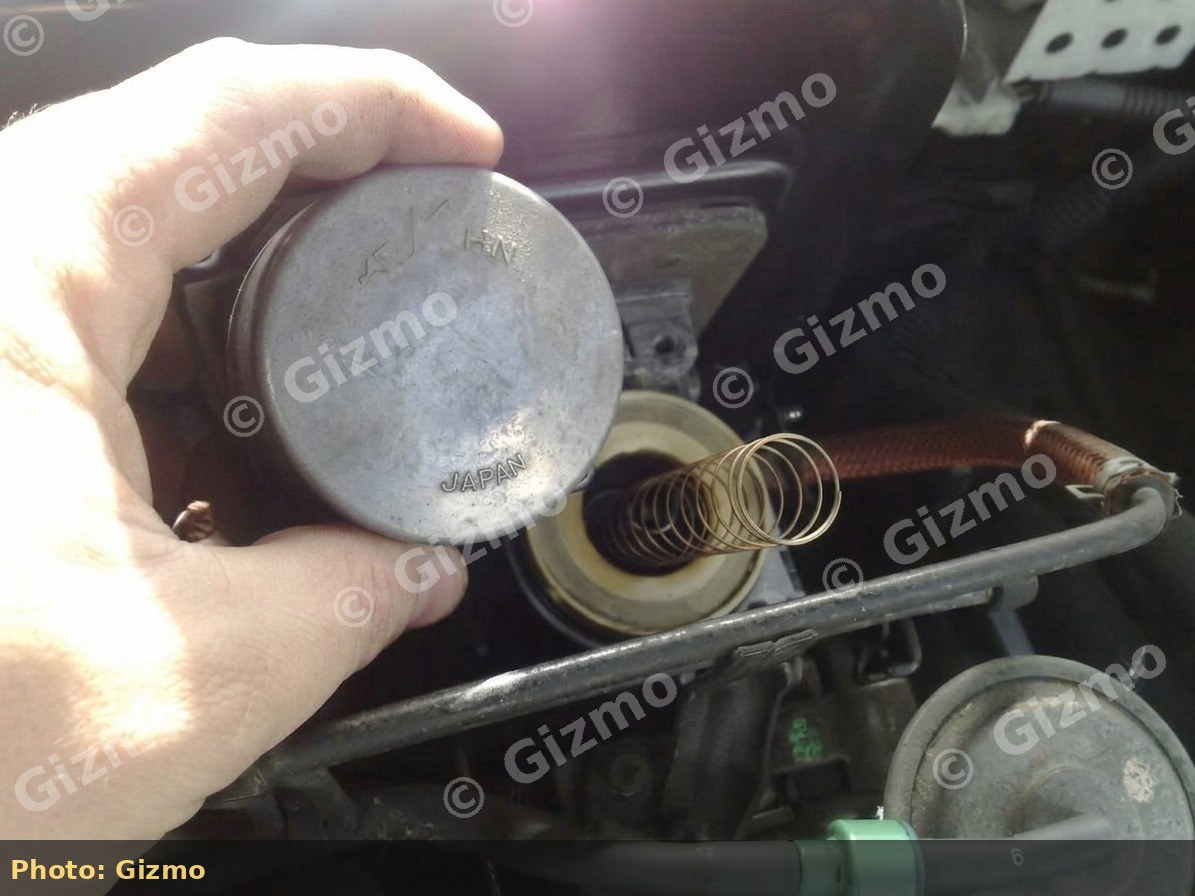
Slide/piston out for cleaning (Gizmo).
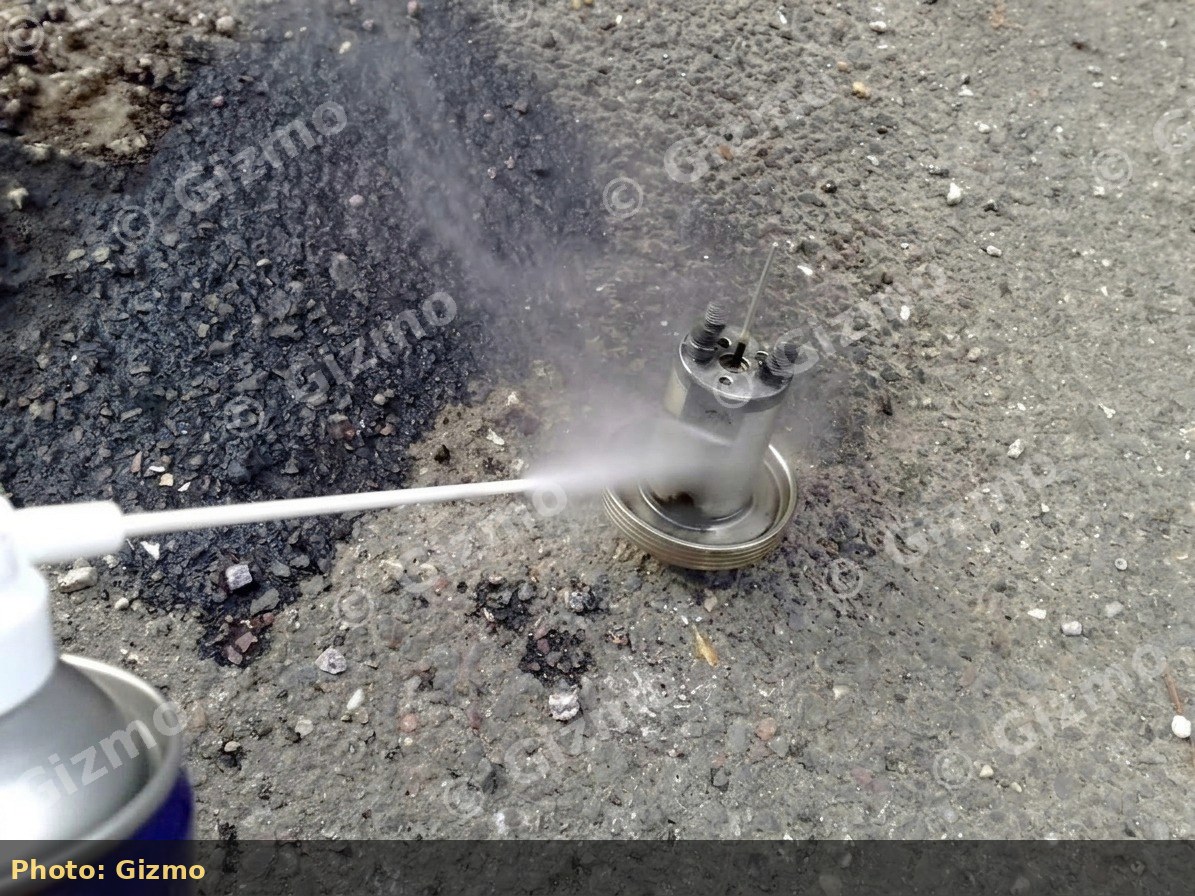
Piston/needle clean with aerosol carb cleaner (Gizmo).
Re-balance and re-set mixture after any full clean. Expect idle rpm to change once passages flow again.
Wideband reality check (dual-carb D15B4)
Logged cruise around 12.5-13.5:1 and WOT around 9.8-10.5:1 is common on lightly modified dual-carb cars before main-jet work. Cutting springs without a gauge is not a substitute for jetting. See Street Tuning Dual-Carburetor Honda D-Series Engines0 for the full AFR table from that log.
Spring mod interaction
If you also cut or stiffen slide springs (see Street Tuning Dual-Carburetor Honda D-Series Engines0):
- Cut-and-stretch can feel sharper but may lean high rpm if mains/needles are unchanged - or richen part throttle by restricting slide rise (both outcomes appear in owner force and wideband tests).
- Force testing has shown cut-and-stretched springs can be stiffer at full compression than stock.
- Some owners run two springs (progressive) instead of a cut spring so the slide rises more softly early and resists full rise at WOT.
- After any spring change, repeat mixture, balance, and WOT AFR.
Aftercare
- Refit airbox or filters securely.
- Cap mixture screw ports if required for emissions legality.
- Log cruise and WOT AFR before changing main jets or removing slide restrictors.
- For springs, jets, and overall build order, see Street Tuning Dual-Carburetor Honda D-Series Engines0.
Applies to
3 taxonomy linksCredits and source
Source Adapted from Dual carb tuning on a D14A1, my own experiences on 4GUK. Licensed under All rights reserved.
Source Adapted from Adjusting air/fuel mixture on dual carbs GL d14a1 on 4GUK. Licensed under All rights reserved.
Source Adapted from Location of air/fuel mixture screws on D14A1 on 4GUK. Licensed under All rights reserved.
Source Adapted from Dual Carb Tuning Guide on 4GUK. Licensed under All rights reserved.
Source Adapted from D14A1 cleaned Carbs results on 4GUK. Licensed under All rights reserved.
Source Adapted from D15B4 (AUDM) Dual Carb tuning - with wideband and AFM on 4GUK. Licensed under All rights reserved.
Source Adapted from How To - Carb Cleanup and Refresh on 4GUK. Licensed under All rights reserved.