Street Tuning Dual-Carburetor Honda D-Series Engines
Still-carbureted street tuning for Honda dual Keihin D-series (D14A1, D15, D16): airbox, exhaust, springs, needles, jets, dyno lessons, and a staged build order.
Adapted from Dual Carb Tuning Guide , Dual carb tuning on a D14A1, my own experiences , how do u fasten up a 1400 dual carb engine , 1.4 GL dual carb tuning , OEM Dual Carb Needle Specs , How To - customize your carb springs , D14A1 Dual Carb cone filter mod , D14a1 cam regrind , D14's and Aftermarket Exhaust Manifolds , How To - Carb Cleanup and Refresh , D15B4 (AUDM) Dual Carb tuning - with wideband and AFM , D14A & dual carb GL engine just a few questions , d14 bike carbs help? , D15B4 (AUDM) Dual Carb tuning - with wideband and AFM , d14a1 boring me , How To - Dual Carb VTEC Mini-Me

This guide covers practical, still-carbureted street tuning for Honda dual-carb (twin Keihin CV) D-series engines, especially the D14A1 1.4 used in fourth-generation Civic GL and related CRX / Concerto applications. The same principles apply to dual-carb D15 and D16 variants.
Important
Across roughly ten dual-carb cars logged in community testing, stock setups commonly ran about 11:1 AFR at WOT and 12:1 cruising: far richer than needed. That hurts economy and masks real power. Use a wideband (or CO meter at idle) before chasing hard parts.
Prerequisites
Work only on a healthy engine:
- Fresh service: plugs, oil, filters, valve clearances in specification (community claims a neglected service can leave double-digit horsepower on the table versus a well-serviced stock dual-carb car)
- Carburetors cleaned or rebuilt; no vacuum leaks; choke working
- Ignition timing at the service-manual baseline before you advance it
- No exhaust leaks that corrupt AFR readings
CRX dual-carb note: some 1.5 dual-carb CRX cars use a bulkhead vacuum control box tied into an ECU-style control path. Do not randomly unplug vacuum lines on those cars without understanding the circuit.
Air / fuel targets
| Condition | Typical target | Notes |
|---|---|---|
| Stoichiometric (cruise compromise) | ~14.7:1 | Economy baseline |
| Safe NA peak power (street) | ~12.8-13.8:1 | Avoid “dark side” lean WOT on a road car |
| Common stock dual-carb WOT | ~11:1 | Excessively rich |
| Boosted (if ever supercharged/turbo on carbs) | ~12:1 | Separate project; listed only as reference |
Cold air is denser and supports more power for a given throttle opening. Carbs will run on hot bay air, but colder air is better. Removing the exhaust-heat feed into the airbox after warm-up is a common first step.
Wideband-logged dual-carb example (D15B4 AUDM)
One owner fitted an AFM + wideband on an Australian dual-carb D15B4 (extra emissions hardware on that market) with mild free-flow and open throats. Reported logs:
| Condition | Observed AFR | Notes |
|---|---|---|
| Cruise (cut/stretched springs) | ~12.5-13.5:1 | Too rich for light load / economy |
| Very light throttle | down toward ~14.5:1 | Still not lean cruise |
| WOT | ~9.8-10.5:1 | Extremely rich; only leaned to ~10.5 after 5k |
| Partial throttle, no springs | ~14-16.5:1 | Too lean / hesitant until more throttle |
Takeaways that match other dual-carb logs:
- WOT is main-jet territory - idle mixture screws do not fix full-load richness.
- Cut-and-stretch springs on that car richened part-throttle (restricting slide rise / air) rather than “leaning everything out.”
- Only the slow running circuit is externally adjustable on many of these Keihins; mains need bowl work to change.
Do not copy those AFRs as targets - use them as proof that stock-ish dual carbs often sit richer than folklore, and that spring folklore needs a gauge.
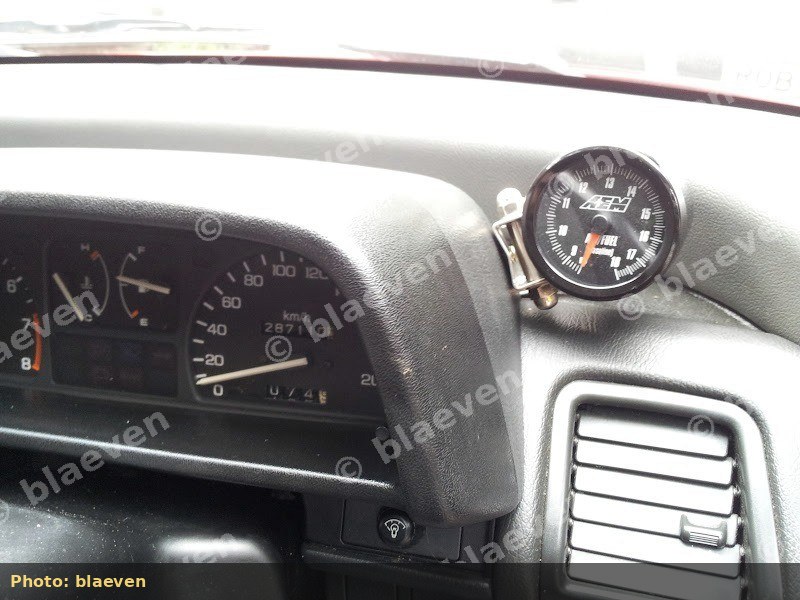
Dash-mounted wideband gauge used while logging dual-carb AFR (blaeven).
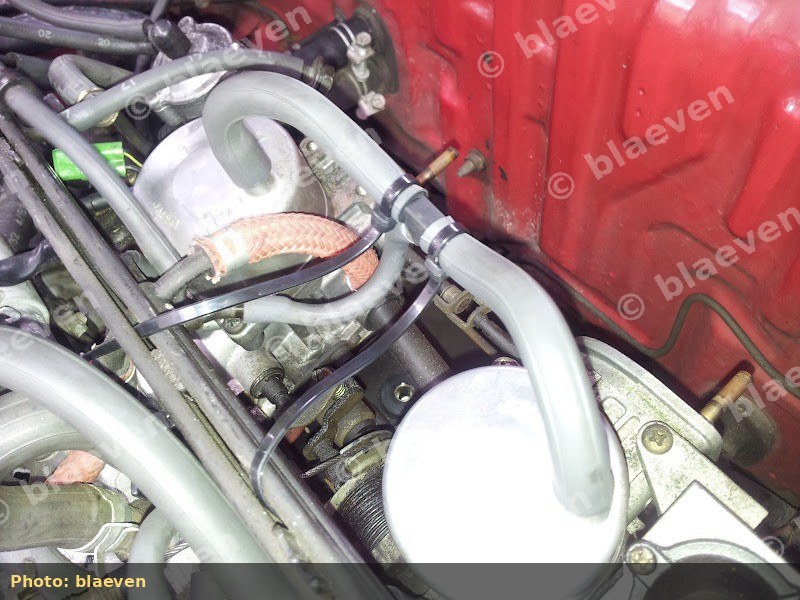
Dual Keihin bay with emissions plumbing and free-flow intake work (blaeven).
Stage 1: free and low-cost mods
Stock airbox improvements (preferred street path)
Many stronger street dual-carb D-series cars stay on a drilled stock box + panel filter, not open stacks.
- Remove the airbox lid (four clips + centre wing nut toward the bulkhead on typical layouts).
- Unhook vacuum lines and the exhaust heat transfer pipe that feeds warm air into the box.
- Remove the airbox base (3-4 × 10 mm nuts).
- Delete the heat pipe path and the restrictive internal flap.
- Fit a high-flow panel filter (K&N-style or equivalent; one commonly cited dual-carb panel is in the K&N E-series range - confirm fitment for your box).
- Optionally drill extra inlet holes in the box once flap/heat are sorted.
Warning
A cone filter only on the end of the factory snorkel is widely considered pointless or restrictive. Fix the box internals first.
Cold start: these airbox mods do not change the choke circuit; winter starting behaviour stays the same if the choke is healthy.
Full exhaust and header
- Free-flow system helps a dual-carb D14 more than open filters alone.
- 4-2-1 headers for street low/mid torque and clearance; 4-1 for higher rpm (often hangs lower).
- See D14 Dual-Carb Exhaust Manifold Selection0.
Ignition timing
After breathing and mixture are sensible:
- Loosen the distributor clamp (often 10-12 mm bolts - use what fits your dizzy).
- Advance carefully (commonly rotating the body toward the firewall / anti-clockwise from the driver’s side - confirm on your chassis).
- Road-test; retard immediately if detonation (ping/knock) appears.
- Higher-octane fuel increases safe advance margin.
Example community baselines on dual-carb GLs:
- About 97 bhp with careful timing advance only (stock-ish car, dyno day).
- About 96.9 bhp with open filters/air feed, spring mod, and a free rear box (still near-stock otherwise) - same ballpark: free breathing and timing move a healthy dual-carb D14, but not into high three-digit territory.
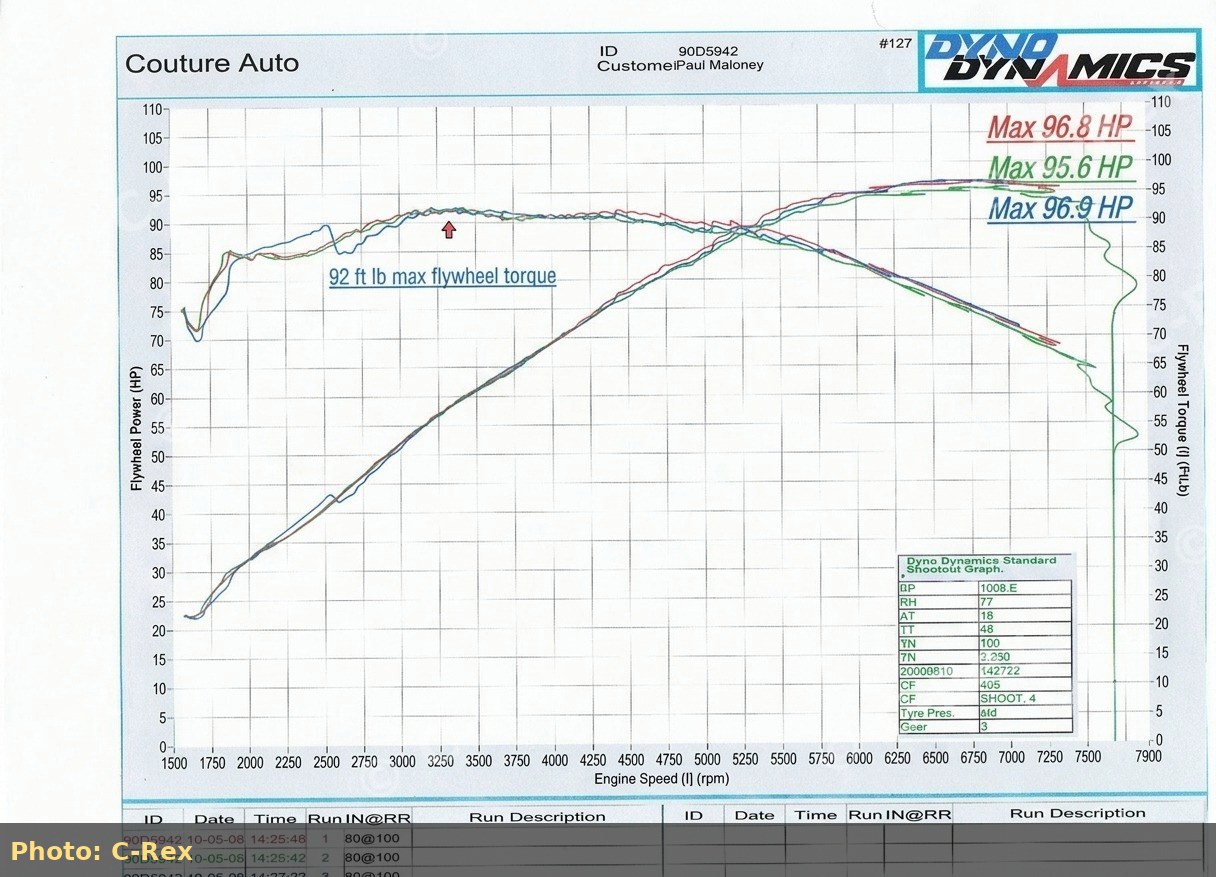
Example dual-carb street dyno near 96.9 hp / ~92 lb·ft (C-Rex).
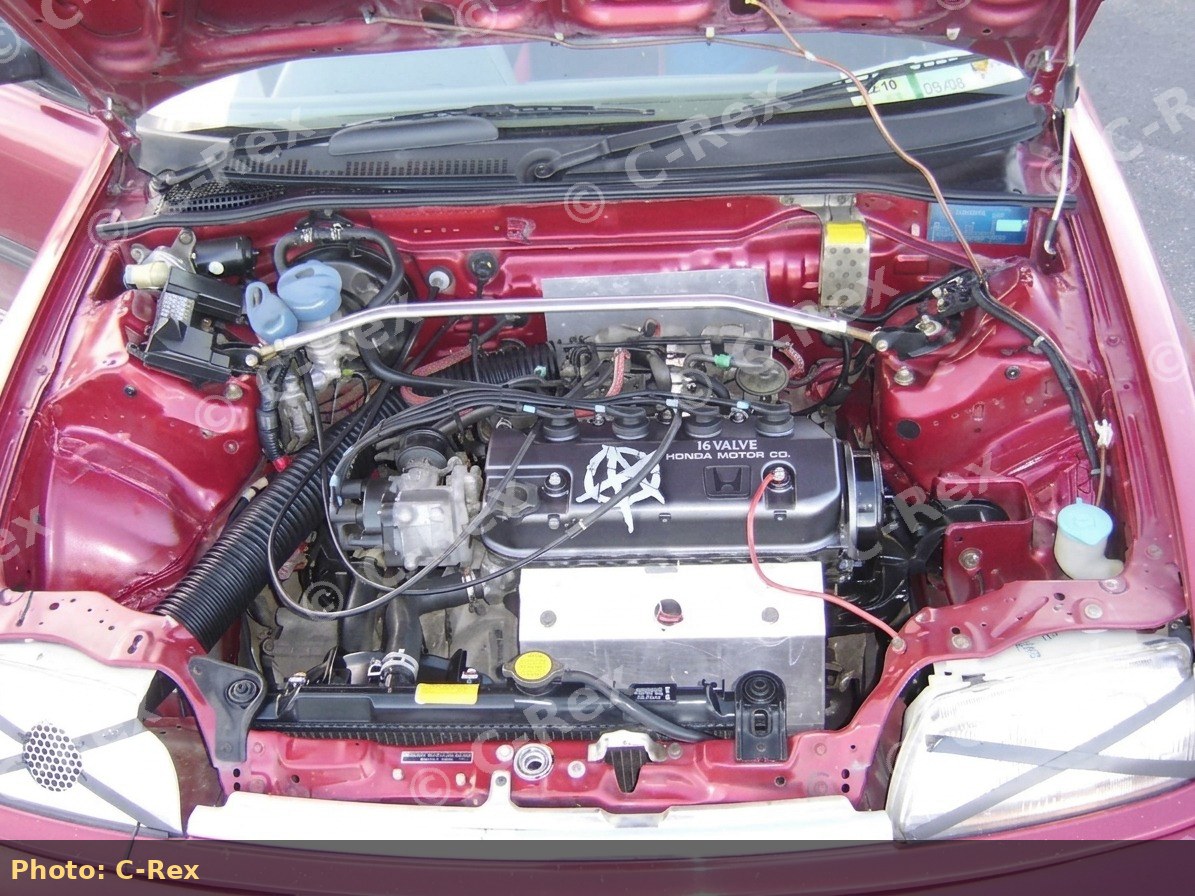
Typical dual-carb 1.4 bay context for those street figures (C-Rex).
Idle speed
Reset tick-over with the throttle-stop / idle screw on the carb linkage after any mixture or spring work. See Setting Idle Mixture and Balancing Dual Carbs on a D14A10.
Stage 2: carburetor internal work
Accessing the slides
- Undo the two screws on each carb top.
- Lift carefully - a spring under the top will push upward.
- Note orientation of the black slide restrictor cap, needle, and spring.
Slide springs
Common modification: cut about four coils, stretch back to stock free length, reinstall cut end down.
Intent: less resistance so the vacuum piston rises sooner → sharper response.
Counter-evidence (measure, do not assume):
- Owner force testing: a stock spring needed about 13.7 N·m to a set height; the same spring cut and stretched needed about 19.4 N·m to the same height - i.e. stiffer at full compression, which can lean WOT if fuel is not increased.
- Some cars run poorly below ~3,000 rpm after a spring cut, then pull hard above - often mixture/transition, not “free power.”
- One approach for open stacks that go rich at WOT is a stiffer spring (or stacked springs) so the slide does not jump fully open too early - opposite of the cut-and-stretch folklore.
- Straight advice from “fasten up a 1400 dual carb” threads: do not cut the springs as a first move; use panel filter, drilled box, full exhaust, and a service.
Warning
Treat spring cutting as optional and AFR-verified. Real power still needs jets, needles, cam, and timing - not springs alone.
Slide restrictor cap
Leave the black restrictor in place for mild street work. Removing it lets the needle lift higher at WOT and often dumps excess fuel (economy loss, long-term bore wash risk). Only revisit with full exhaust, open filters, and wideband jetting.
Idle mixture screws
Mild-tune starting point from dual-carb road logging: seat lightly, then open about 1 turn (not the older “3 turns out,” which many found too rich low down). Finalise with CO or wideband.
On D14A1 dual carbs, screws often sit under white plastic blanking plugs on each body. Adjust both sides equally.
Needles
Community caliper notes on OEM dual-carb main needles (measure your set; dimensions in inches as posted):
| Code / application | A (idle/cruise) | B (cruise-to-load) | C (full load) |
|---|---|---|---|
| 8QCA (D14) | 0.917 in | 0.097 in | 0.052 in |
| 8P (D15) | 0.943 in | 0.097 in | 0.046 in |
| 8QA (D15 variant) | 0.917 in | 0.097 in | 0.052 in |
- A thinner C section generally means richer at full load (D15 8P vs D14 8QCA in that table).
- D15 / CRX dual-carb needles are a common mild swap onto a D14 for a more aggressive taper.
- D15B needles are also used with stacks to add fuel at certain throttle openings.
- Concerto 1.6 dual-carb needles are sometimes mentioned as interchangeable candidates; verify physically.
- Always re-check cruise and WOT AFR after a needle change.
Jets (main vs slow)
| Item | Location / notes | Community sizes |
|---|---|---|
| Main jet | Screws into the emulsion tube (~1 in long) in the bowl; under the needle circuit | Often marked 180 (~1.80 mm) on some dual-carb sets |
| Slow / pilot jet | Separate small jet (do not confuse with mains when shopping) | Varies - measure what you have |
| D15B example | Mains pulled from some D15B dual carbs reported as 160 | Different calibrations exist - never assume |
Parts diagrams commonly label main jet, emulsion tube, and slow jet as distinct items (e.g. positions 26 / 18 / 27 on some Honda dual-carb breakdowns - verify against your carb family).
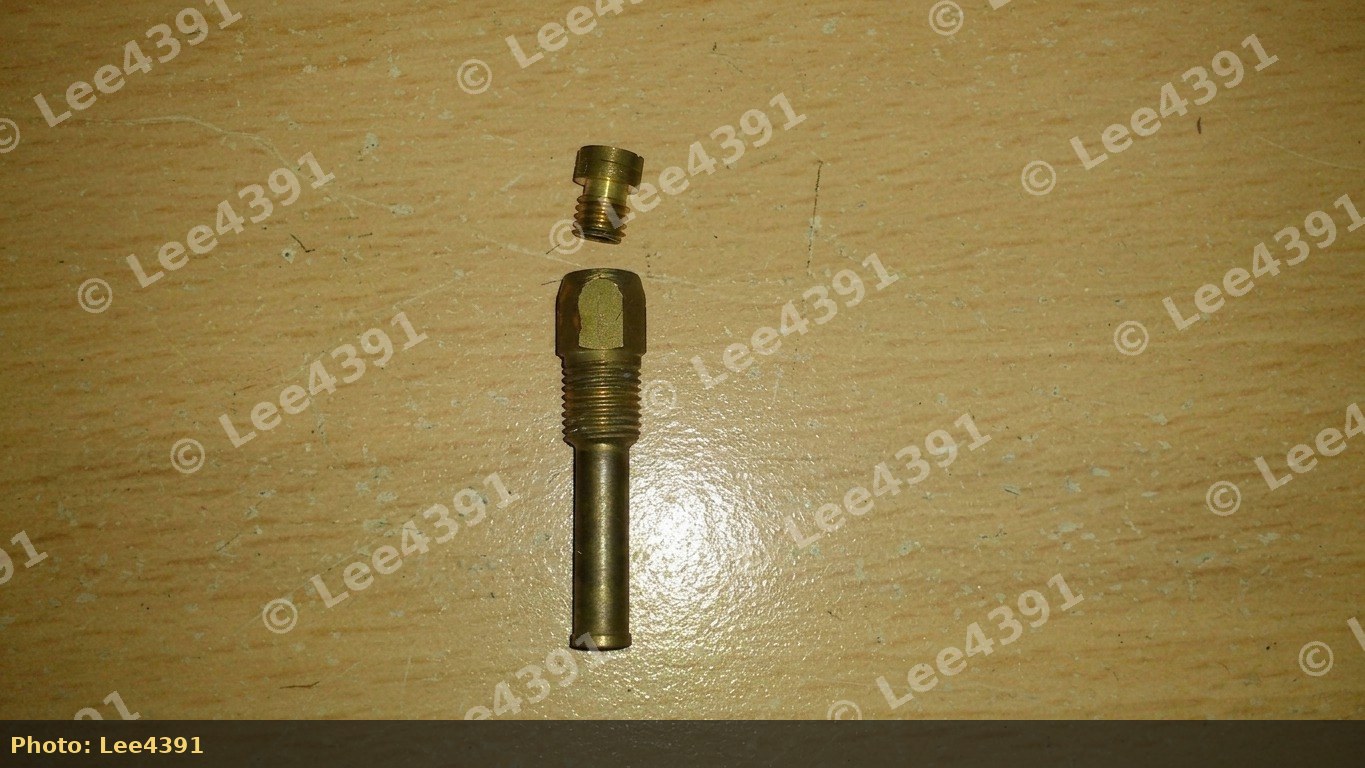
Main jet screwed into emulsion tube (Lee4391).
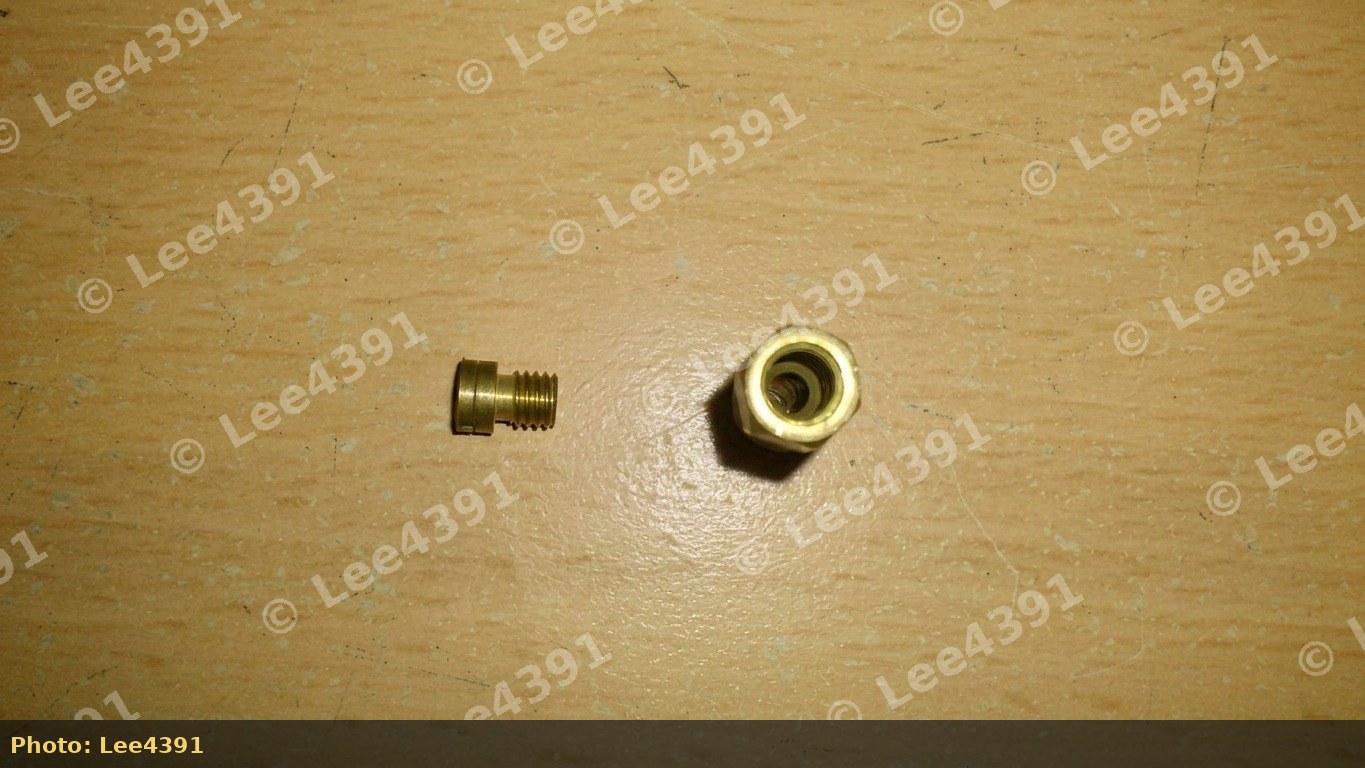
Jet and emulsion tube body separated (Lee4391).
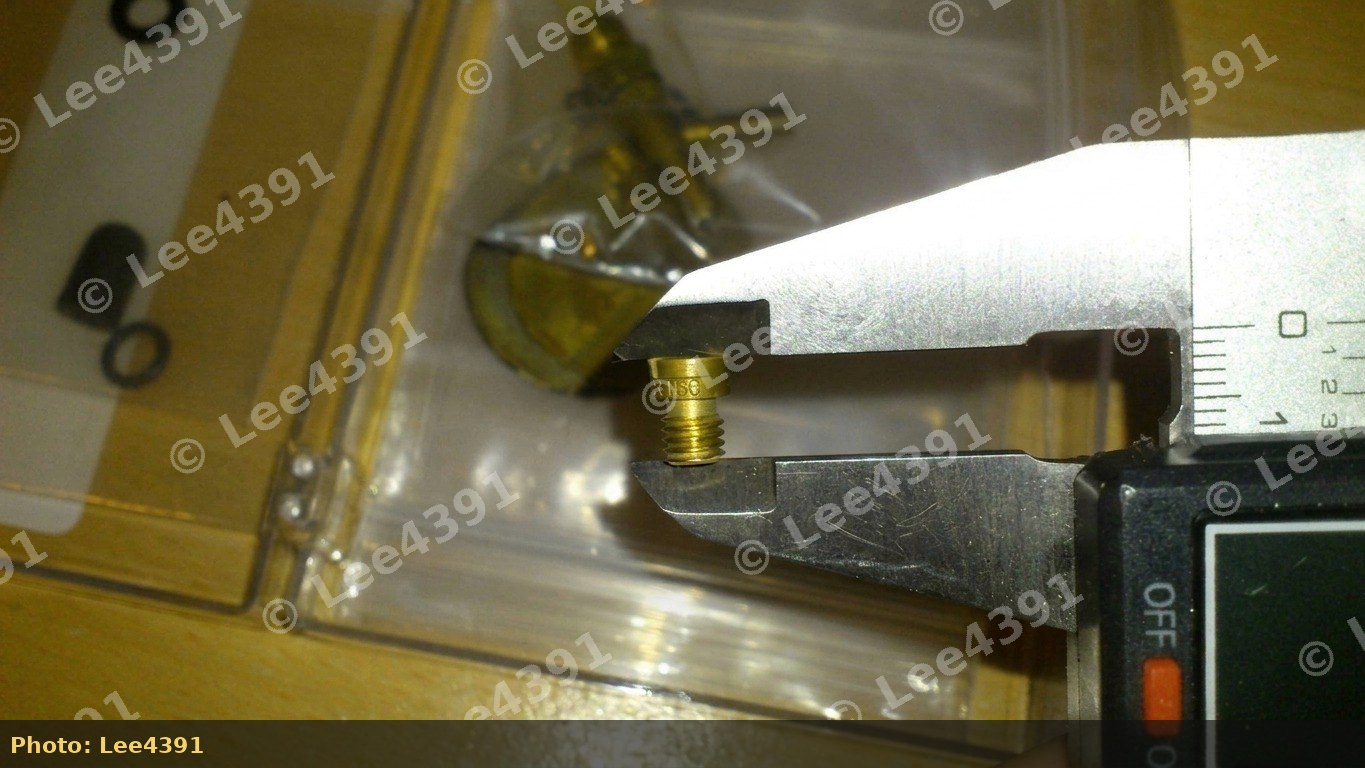
Example main jet marked 180 (~1.80 mm) (Lee4391).
Stage 3: intake philosophy (still carbed)
| Approach | Pros | Cons |
|---|---|---|
| Drilled stock airbox + panel filter | Filtration, easier cold air, used on many strong street cars | Less induction noise |
| Velocity stacks + foam / ram socks | Sound; can help if jetted; stack length moves the torque band | Heat soak, dirt, often lean without fuel work |
| Cone on snorkel only | Easy | Little or no benefit |
Dyno-backed illustration (built dual-carb D15 CRX, controlled fan, 7600 rpm limit - not a stock D14):
| Intake on that build | Peak (approx.) |
|---|---|
| Modified stock airbox + panel | ~129 bhp / ~123 lb·ft |
| Bike-style filters on the carbs | ~137 bhp / ~126 lb·ft |
| Large oval foam filter | ~138 bhp / ~127 lb·ft |
On that car, open filters won peak power with a bonnet-up cold fan; a stock-box-style path held more low-down torque but less peak. A stock dual-carb GL on the same day made ~97 bhp with timing work only. Do not expect stock D14A1 numbers in that 130+ range without head, manifold, and fuel work - the table shows relative intake behaviour on a sorted dual-carb engine.
Venturi vs harmonics: short stacks help low-speed air speed; at higher rpm, runner length and wave tuning matter more than “more hole.”
Stage 4: further NA power (still carbed)
Only after Stages 1-3 and solid AFR logs:
- Mild cam (OEM dual-carb swaps or regrinds; Bisimoto-type grinds are often suggested for high-rpm pull). Match valve springs and fueling. See Camshaft Upgrades for Dual-Carb Honda D14A1 and D15 Engines0.
- Head skim / port match / manifold port match (as on the high-power dual-carb CRX example)
- Proper main-jet and needle kit with wideband
- Optional bike carbs or dual-carb VTEC mini-me (separate fabrication projects)
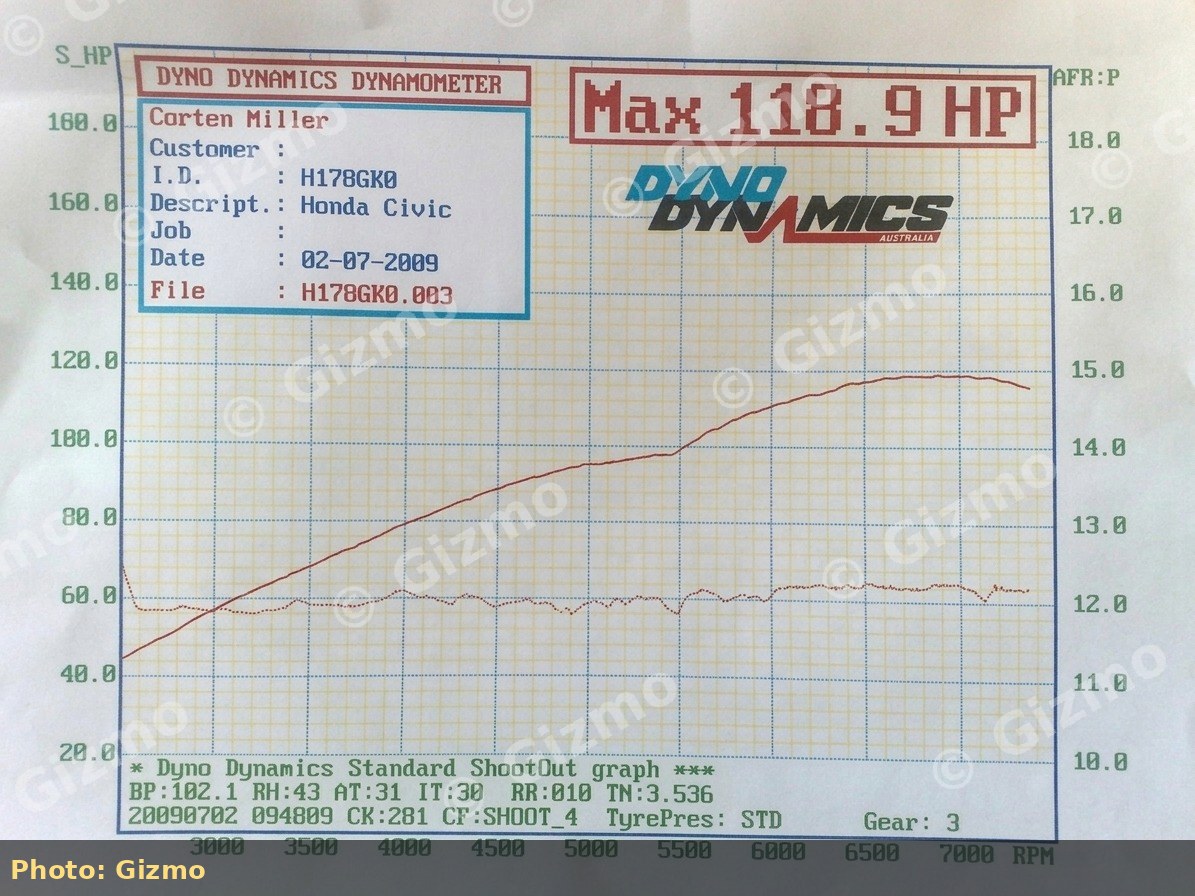
Example dual-carb VTEC mini-me dyno near 119 hp - not a Stage 1 bolt-on (Gizmo).
Bike carbs (FXR / ZXR-style multi-choke): community owners who actually ran them report worse economy unless jetting is carefully set for mpg (one setup burned through a lot of fuel just idling while balancing). Stock dual Keihins were calibrated for economy commuting; bike racks are a smile-per-gallon path, not a free mpg upgrade. See also stack-length notes in Dual-Carb Intake Options0.
Lightened flywheel: a ~4 kg flywheel is a common dual-carb GL complement after breathing work - sharper rev response without changing peak power. Match clutch choice to the dual-carb torque; some Stage-1 D16 hydraulic clutches feel excessively stiff in a light D14 chassis.
Recommended build order (still carbureted)
- Service + carb rebuild/balance
- Airbox flap + heat delete + panel filter (skip spring cuts for now)
- Exhaust + 4-2-1 header
- Idle mixture, balance, careful timing advance
- Wideband log (idle / cruise / WOT)
- Only then: springs, needles, jets, or open stacks
- Cam / head work if still hungry
What not to expect
- A stock D14A1 will not become a race engine on free filters alone; think response, midrange, economy, and clean AFR.
- Open stacks without fuel work frequently lose dyno power (example dual-carb 1.4: ~75 bhp lean, ~86 bhp when enrichment was added).
- Head swaps (D16Z6 still on carbs) and bike-carb conversions are not Stage 1.
Safety
Caution
Lean WOT under load can destroy pistons. Detonation from over-advanced timing does the same. Road cars should not be tuned on the “lean for max power” edge without rebuild budget.
Applies to
3 taxonomy linksCredits and source
Source Adapted from Dual Carb Tuning Guide on 4GUK. Licensed under All rights reserved.
Source Adapted from Dual carb tuning on a D14A1, my own experiences on 4GUK. Licensed under All rights reserved.
Source Adapted from how do u fasten up a 1400 dual carb engine on 4GUK. Licensed under All rights reserved.
Source Adapted from 1.4 GL dual carb tuning on 4GUK. Licensed under All rights reserved.
Source Adapted from OEM Dual Carb Needle Specs on 4GUK. Licensed under All rights reserved.
Source Adapted from How To - customize your carb springs on 4GUK. Licensed under All rights reserved.
Source Adapted from D14A1 Dual Carb cone filter mod on 4GUK. Licensed under All rights reserved.
Source Adapted from D14a1 cam regrind on 4GUK. Licensed under All rights reserved.
Source Adapted from D14's and Aftermarket Exhaust Manifolds on 4GUK. Licensed under All rights reserved.
Source Adapted from How To - Carb Cleanup and Refresh on 4GUK. Licensed under All rights reserved.
Source Adapted from D15B4 (AUDM) Dual Carb tuning - with wideband and AFM on 4GUK. Licensed under All rights reserved.
Source Adapted from D14A & dual carb GL engine just a few questions on 4GUK. Licensed under All rights reserved.
Source Adapted from d14 bike carbs help? on 4GUK. Licensed under All rights reserved.
Source Adapted from D15B4 (AUDM) Dual Carb tuning - with wideband and AFM on 4GUK. Licensed under All rights reserved.
Source Adapted from d14a1 boring me on 4GUK. Licensed under All rights reserved.
Source Adapted from How To - Dual Carb VTEC Mini-Me on 4GUK. Licensed under All rights reserved.