Camshaft Upgrades for Dual-Carb Honda D14A1 and D15 Engines
Cam choices for still-carbureted Honda D14A1 and dual-carb D15 engines: D15 OEM swap, Bisimoto-type regrinds, supporting fueling, and build order.
Adapted from D14 Bisimoto cam update , D14a1 cam regrind , D Series OEM Camshaft Specs (Non VTEC) , cams for gl , Suitable cam upgrade for D15B (jdm twin carb) , Does mini-me d14a1 block with d16 vtec head pay off? , The ED2 GL - Project Jap Scrap - Manual Box, Trumpets & Cam! , Dual Carb Tuning Guide , d14a1 cam conversion , d14al cam swap ? , D15b Cam Swap Questions , How To - Dual Carb VTEC Mini-Me

Cam work is the usual next step after airbox, exhaust/header, mixture, and balance on a dual Keihin D-series that will stay carbureted. A freer cam only helps if the engine can fill the cylinders and the carbs still supply the fuel - otherwise the car just goes lean or peaky.
Important
Fit breathing and fueling first (service, airbox or properly jetted stacks, free-flow exhaust, mixture/balance, wideband). A cam on a dirty dual-carb D14 is an expensive way to learn that lesson.
Why cam the dual-carb D14 / D15?
| Goal | Realistic outcome on dual carbs |
|---|---|
| Mild street response | OEM D15 dual-carb cam in a D14 is the common junkyard step |
| Stronger mid/high rpm | Aftermarket regrind (Bisimoto-type profiles are repeatedly cited on dual-carb GLs) |
| High-rpm pull toward 7-8k | Aggressive regrind + springs, careful timing, and jetting - not a first mod |
| Maximum power | Head work, manifold match, fuel (jets/needles or conversion) usually matter more than the cam alone |
Stock dual-carb D14A1 cars are economy-oriented. Community dual-carb street builds that advertise serious wheel figures almost always list a cam package with the rest of the bolt-ons. Documented dual-carb GL / D14 packages include roughly 116 bhp (Bisimoto stage-1 style cam, stock airbox, ~1.75 in exhaust), ~122 whp, and signature notes around ~127 whp @ ~6200 rpm on fuller builds (not cam-only).
OEM lobe sizes (community caliper measurements)
Forum non-VTEC SOHC lobe base diameter and lift notes (measure your own cam; treat as comparative, not factory print):
| Cam | Intake base (lift) | Exhaust base (lift) | Notes |
|---|---|---|---|
| D14 | 36.50 mm (4.5 mm lift) | 36.30 mm (4.3 mm lift) | Stock dual-carb GL |
| D15B | 37.00 mm (5.0 mm lift) | 36.80 mm (4.8 mm lift) | Common mild upgrade into D14 |
| D16Z1 | 37.50 mm (5.5 mm lift) | 37.00 mm (5.0 mm lift) | Often pulled from Concerto; less often fitted than D15B |
That is why a D15B cam is the usual first step: a real but modest lift increase without a full regrind.
Option 1: OEM D15 dual-carb cam in a D14 (mild)
What people report
- A D15B cam is a straightforward lift bump over stock D14 (see table above).
- The rocker assembly is the same family as the D14 dual-carb head; some owners fit the complete rocker assembly with the cam.
- At least one dual-carb GL diary notes fitting a D15 cam by careful timing-belt work without a full strip.
- D15B / D15A1 cams show up in EG Civics, Concertos, and related scrapyard SOHC non-VTEC heads.
- For dual-carb engines that still use a mechanical fuel pump, use a cam that retains the fuel-pump lobe - community consensus is D15B non-VTEC and D16Z1 are the usual safe donors; many other SOHC cams omit that lobe.
- Idle and cold-start problems after a D15B swap are not automatic. Several dual-carb GLs report no idle/startup issues when clearances and timing are set; the biggest seat-of-pants change is often a sharper exhaust note, with power gains muted if the exhaust is still restrictive.
- Gains show up more after free-flow exhaust and mixture work - the cam alone on a stock cast manifold is easy to under-appreciate.
Tip
“Even a D15 cam in a D14 helps” is a recurring community summary when discussing still-carbureted bottom ends, including when comparing mini-me / head options.
Checklist
- Confirm cam and rockers are for the correct SOHC dual-carb head family (do not mix random VTEC rockers without a full plan).
- Set valve clearances cold after install (FSM procedure and values for the head you have).
- Align timing belt marks carefully; dual-carb SOHC is less forgiving of a tooth out than it feels.
- Re-set base ignition timing, then mixture/balance. More cam usually wants more fuel at higher rpm.
- Road-test for valve noise, ping, and flat spots; log AFR if possible.
When it is enough
Use the D15 OEM cam when you want a cheap, reversible step after exhaust and airbox, without paying for a regrind. Expect response and midrange, not a night-and-day top-end on a stock D14 bottom end.
Option 2: OEM D16Z1 cam (next step after D15B)
- D16Z1 lobes measure larger again than D15B (table above).
- Often found in Concerto engines in UK scrapyards.
- Fewer dual-carb GLs actually run one than talk about it; owners who do usually keep dual carbs and add breathing + exhaust.
- An adjustable cam pulley is sometimes discussed when swapping across D-series SOHC cams so you can re-time after the change.
Option 3: Aftermarket regrind (e.g. Bisimoto / Newman-type)
What the dual-carb community uses them for
- Bisimoto and UK regrind shops (e.g. Newman quoted around £200 on a stock D14 blank in one thread) are the usual answer when someone wants a dual-carb D14 that pulls harder high in the rev range (including “toward 8k” wish-list posts).
- Some Bisimoto stage-1 profiles are described as relatively mild; still enough, with a free exhaust and sorted airbox, to land around 115+ bhp on a dual-carb GL in community reports.
- One dual-carb D14 Bisimoto diary discusses power moving up the rev range, with peak torque around ~5300 rpm on that package (trade some low-end plumpness for higher-rpm work).
- Owners often send a D15B core to the regrinder rather than a worn D14 blank.
- Builds that publish ~122 whp or ~127 whp @ ~6200 with dual carbs + Bisimoto also run the rest of the package (exhaust, induction, tune). Do not expect stock carbs and a cam alone to match those figures.
Supporting work after a regrind
| System | Why |
|---|---|
| Valve springs / retainers | Aggressive lobes need stable control at the new rpm |
| Carb jets / needles | Higher airflow at peak rpm leans stock mains |
| Exhaust (often 4-2-1 or free 1.75 in system) | Cam without exit flow wastes the grind |
| Ignition advance | Re-optimise; listen for detonation |
| Wideband | Mandatory for street reliability |
Warning
Asking a dual-carb D14 to live at high rpm with stock springs, stock jets, and a hot grind is how you get valve float, lean holes, or melted pistons. Stage the supporting mods.
Option 4: Other paths (context)
| Path | Dual-carb street notes |
|---|---|
| Stay stock D14 | Fine for reliability; combine with airbox/exhaust/tune first |
| D15B SOHC non-VTEC | Preferred mild OEM upgrade into D14 |
| D16Z1 SOHC non-VTEC | Next OEM step; Concerto is a common donor |
| Random FI SOHC cams | May share journals but lobe design and idle vacuum can fight CV carbs; verify case-by-case |
| VTEC head / mini-me | Not a drop-in dual-carb power mod; separate project |
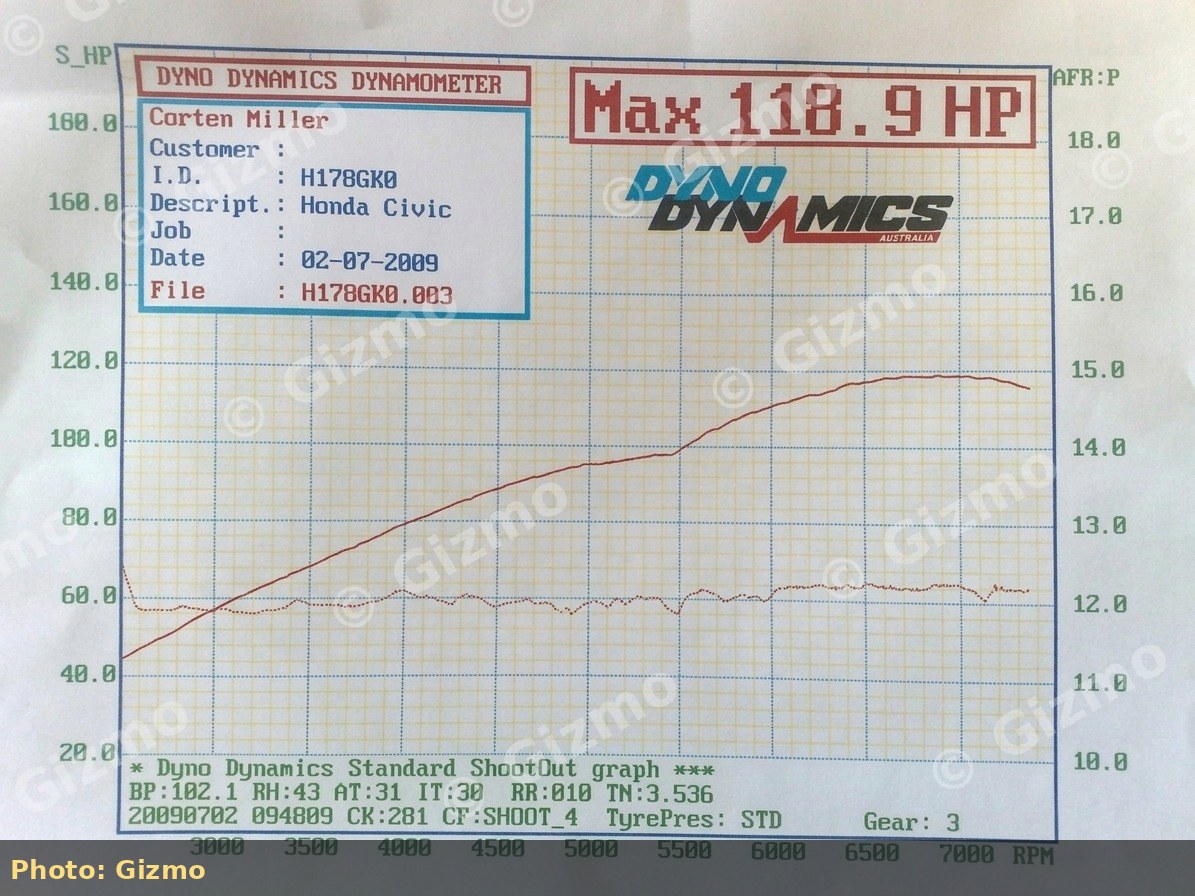
Dual-carb VTEC mini-me package dyno near 119 hp - cam/head work class, not a mild OEM cam alone (Gizmo).
Always measure a used cam (base diameter and lift) and confirm against the grind card or FSM rather than trusting casting marks alone.
What a cam will not fix
- Dirty or unbalanced dual carbs
- Heat-soaked open stacks with no jetting
- Stock cast manifold into a crushed exhaust
- Detonation from too much advance on low octane
- Expectation of B-series power from 1.4 dual carbs
Community dual-carb tuning guides put cams in the same “real power” list as jets, needles, and timing: after the free breathing work.
Suggested order (still carbureted)
- Service + carb rebuild, mixture, balance
- Airbox flap/heat delete + panel filter (or stacks with fuel work)
- Free-flow exhaust + 4-2-1 header
- Mild timing advance under load
- D15 OEM cam or mild regrind
- Re-jet / needle as AFR demands
- Only then: more aggressive grind, head work, or dual-carb VTEC mini-me
Related articles
- Street Tuning Dual-Carburetor Honda D-Series Engines0
- Setting Idle Mixture and Balancing Dual Carbs on a D14A10
- Dual-Carb Intake Options: Stock Airbox versus Velocity Stacks0
- D14 Dual-Carb Exhaust Manifold Selection0
Safety and reliability
Caution
Always confirm TDC and belt marks. A jumped belt or wrong cam gear index can bend valves on interference D-series engines.
Note
Verify any grind card and clearances against the cam supplier and the Honda factory service manual before assembly.
Applies to
3 taxonomy linksCredits and source
Source Adapted from D14 Bisimoto cam update on 4GUK. Licensed under All rights reserved.
Source Adapted from D14a1 cam regrind on 4GUK. Licensed under All rights reserved.
Source Adapted from D Series OEM Camshaft Specs (Non VTEC) on 4GUK. Licensed under All rights reserved.
Source Adapted from cams for gl on 4GUK. Licensed under All rights reserved.
Source Adapted from Suitable cam upgrade for D15B (jdm twin carb) on 4GUK. Licensed under All rights reserved.
Source Adapted from Does mini-me d14a1 block with d16 vtec head pay off? on 4GUK. Licensed under All rights reserved.
Source Adapted from The ED2 GL - Project Jap Scrap - Manual Box, Trumpets & Cam! on 4GUK. Licensed under All rights reserved.
Source Adapted from Dual Carb Tuning Guide on 4GUK. Licensed under All rights reserved.
Source Adapted from d14a1 cam conversion on 4GUK. Licensed under All rights reserved.
Source Adapted from d14al cam swap ? on 4GUK. Licensed under All rights reserved.
Source Adapted from D15b Cam Swap Questions on 4GUK. Licensed under All rights reserved.
Source Adapted from How To - Dual Carb VTEC Mini-Me on 4GUK. Licensed under All rights reserved.